Eye Conditions and Treatments
Age-related macular degeneration (AMD)
A common eye disease in older age, AMD affects your central vision.
Call us now at 905-721-1211 with any questions or to schedule an appointment.
What Is Age-Related Macular Degeneration
Age-related macular degeneration (AMD) is one of the leading causes of vision loss in adults over the age of 60 and is responsible for a large proportion of new cases of legal blindness in Canada. AMD affects the macula, a small but critical area at the center of the retina located at the back of the eye.
The macula is responsible for sharp central vision, which allows us to perform tasks that require fine visual detail such as reading, recognizing faces, driving, and viewing objects clearly. AMD occurs when the light-sensitive cells in the macula gradually deteriorate or become damaged. The most common visual symptom of AMD is loss of central vision. Although peripheral (side) vision usually remains intact, individuals with AMD may have difficulty seeing objects directly in front of them or focusing on detailed tasks.
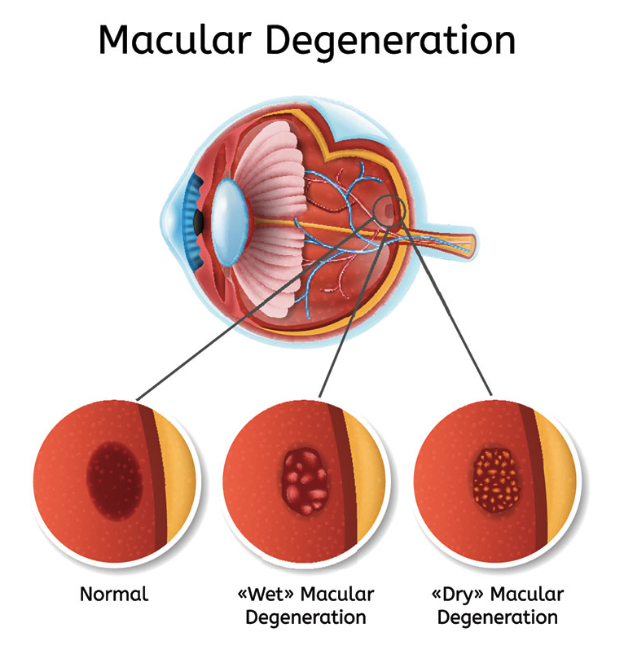
There are two main types of age-related macular degeneration: Dry AMD and Wet AMD.
Types of Age-Related Macular Degeneration
Dry AMD
Dry AMD, also known as atrophic AMD, is the most common form and accounts for approximately 90% of cases. In this form of the disease, the macula gradually becomes thinner over time. Small deposits of waste material accumulate beneath the retina, leading to progressive damage of the macular cells.
This process typically develops slowly and results in a gradual loss of central vision.
Wet AMD
Wet AMD, also referred to as exudative AMD, occurs in approximately 10% of individuals with AMD but tends to be more severe and can lead to rapid vision loss.
In wet AMD, abnormal blood vessels grow beneath the retina. These fragile vessels may leak blood or fluid, which damages and scars the macula. As a result, individuals may experience distorted vision, dark spots, or a central blind area in their field of vision.
Ongoing research continues to advance the understanding and treatment of AMD. Effective medications are now available to slow the progression of wet AMD and, in many cases, improve vision. New therapies for dry AMD are currently being studied in clinical trials. Additionally, tools such as magnifiers,
specialized reading lamps, and other low-vision aids can help individuals with AMD maximize their remaining vision.
Causes of Age-Related Macular Degeneration
The exact cause of AMD is not fully understood. However, it is believed to develop due to a combination of aging, genetic factors, and environmental or lifestyle influences that affect the health of the retina and macula.
Risk Factors
Age is the most significant risk factor for developing AMD. However, several other factors may increase the likelihood of developing the condition, including:
- Having blue or light-colored eyes
- High blood pressure
- Heart disease
- High cholesterol
- Smoking
- Being overweight
- Consuming diets high in saturated fats such as butter or cheese
- Having a family history of age-related macular degeneration
Understanding and managing these risk factors can play an important role in protecting long-term eye health.
Diagnosis
Early signs of age-related macular degeneration can sometimes be detected at home using a simple visual test called an Amsler Grid.
When performing this test, patients cover one eye at a time and focus on the grid pattern. If the lines appear wavy, distorted, blurry, or missing, it may indicate changes in the macula and should be evaluated by an optometrist or ophthalmologist.
Regular comprehensive eye examinations are essential for detecting AMD in its early stages and monitoring its progression.
Treatment Options
Treatment for AMD depends on the type and stage of the disease.
Dry AMD Treatment
Dry AMD typically progresses slowly over several years. Research shows that normal visual activities such as reading or using the eyes for close work do not accelerate the progression of the condition.
A specific vitamin and antioxidant supplement formula developed through the Age-Related Eye Disease Study (AREDS) has been shown to reduce the risk of advanced dry AMD progressing to wet AMD in certain patients.
In addition, several promising therapies for dry AMD are currently undergoing clinical trials.
Wet AMD Treatment
Wet AMD can lead to rapid vision loss, making early diagnosis and prompt treatment extremely important. Individuals with AMD should regularly monitor each eye and report any sudden vision changes immediately.
The most common treatment for wet AMD involves anti-vascular endothelial growth factor (anti-VEGF) injections administered directly into the eye. These medications work by stopping the growth of abnormal blood vessels and reducing fluid leakage beneath the retina.
Anti-VEGF treatments are highly effective. With regular therapy, up to 90% of treated eyes stabilize, and approximately one-third of patients may experience improvement in vision. Because the effects of these medications gradually wear off, injections must be repeated periodically to maintain results and prevent further vision loss.
Early detection and ongoing monitoring are essential for preserving vision in patients with age-related macular degeneration. At Ajax Ophthalmology Associates, our ophthalmology team provides comprehensive evaluation, advanced diagnostic imaging, and personalized treatment plans to help protect and maintain your vision.